Русский
 Türkçe
 Tiếng Việt
A Practical Setup Guide for Stable Quality & Lower Scrap
In cable manufacturing, tension control on stranding machines is one of those topics everyone thinks they understand—until quality issues start appearing.
What many factories overlook is that fine wire and thick wire behave fundamentally differently during stranding, and using the same tension logic for both often leads to broken conductors, bird-caging, uneven lay length, or long-term fatigue failures.
This guide explains how tension requirements differ between fine and thick wires, how to adjust your stranding machine accordingly, and how equipment design choices directly affect stability, yield, and long-term reliability.
Why Wire Diameter Changes Everything in Stranding
At a basic level, wire diameter determines three critical factors in stranding:
Elasticity and elongation behavior
Sensitivity to tension fluctuation
Tolerance for mechanical stress and friction
Fine wire is flexible but fragile.
Thick wire is strong but mechanically demanding.
Treating them the same is a common—and costly—mistake.
Fine Wire Stranding: Tension Control Priorities
Fine wires are typically used in:
Data cables
Control cables
Automotive signal wires
High-strand-count conductors
Key characteristics of fine wire
Low tensile strength
High elongation sensitivity
Easily damaged by micro tension spikes
Common problems caused by improper tension
Frequent wire breakage at pay-off
Inconsistent lay length
Surface scratches from excessive friction
Hidden conductor fatigue that fails later in testing
Practical tension adjustment guidelines for fine wire
1. Use the lowest stable tension, not “safe” tension
Many operators increase tension to “be safe.”
For fine wire, this does the opposite.
Target principle:
The wire should remain straight and stable, but never stretched.
2. Prioritize tension consistency over tension value
A slightly higher constant tension is safer than a low but fluctuating one.
This is why active pay-off systems are strongly recommended for fine wire stranding. Passive systems often introduce micro-fluctuations that operators cannot see.
3. Minimize friction points along the wire path
Fine wire reacts strongly to:
Sharp guide angles
Poor surface finish on rollers
Misaligned dancer arms
Even small friction changes translate directly into tension spikes.
Thick Wire Stranding: Different Risks, Different Strategy
Thick wires are commonly used in:
Power cables
EV charging cables
Industrial and building cables
Key characteristics of thick wire
High mechanical strength
Lower elongation sensitivity
Greater inertia during rotation
Common problems caused by incorrect tension
Bird-caging during start/stop
Uneven strand compactness
Core deformation
Accelerated bearing and machine wear
Practical tension adjustment guidelines for thick wire
1. Increase base tension, but control inertia
Thick wire requires higher base tension to maintain:
Strand compactness
Stable lay geometry
However, inertia becomes the main enemy—especially during acceleration and deceleration.
2. Synchronize tension with machine speed ramps
Many stranding issues with thick wire occur not at full speed, but during:
Startup
Emergency stop
Speed transitions
Machines without proper tension-speed synchronization often cause sudden strand loosening or compression.
3. Reinforce mechanical alignment
With thick wire, misalignment doesn’t break the wire—it damages the structure.
Pay close attention to:
Pay-off shaft parallelism
Guide roller load rating
Bearing condition under sustained load
Side-by-Side Comparison: Fine Wire vs Thick Wire
| Parameter | Fine Wire | Thick Wire |
|---|---|---|
Base tension level | Low | Medium to high |
Sensitivity to fluctuation | Very high | Moderate |
Main risk | Breakage, fatigue | Bird-caging, deformation |
Pay-off recommendation | Active tension control | Active or reinforced passive |
Startup behavior | Gentle, slow ramp | Controlled acceleration |
Machine Design Matters More Than Operators Think
Many tension problems are blamed on operators—but in reality, machine design sets the limits.
Key features that directly impact both fine and thick wire stranding:
Precision dancer systems
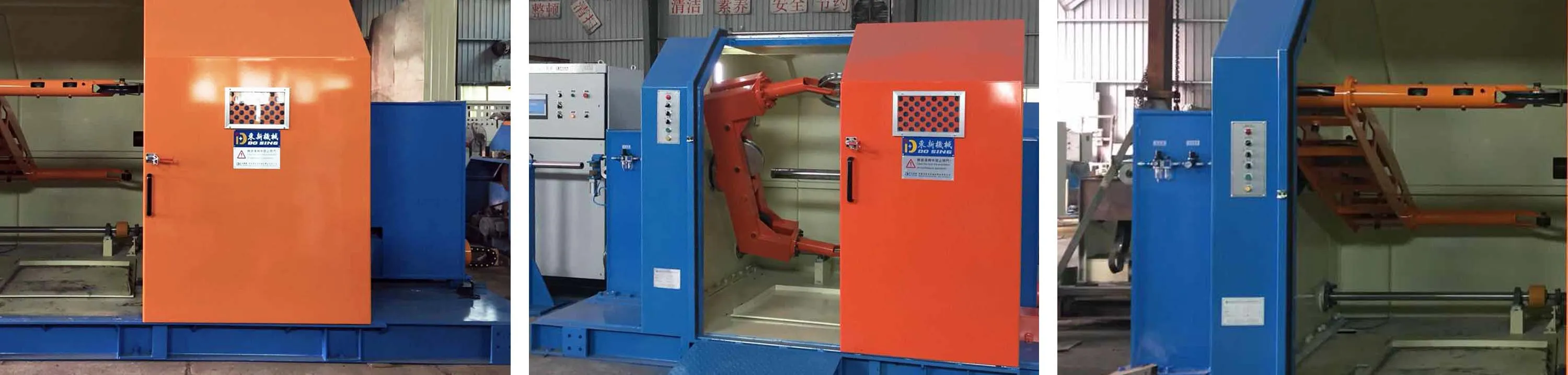
Servo-controlled pay-off units
Stable take-up synchronization
Rigid machine frame to prevent vibration
A well-designed stranding machine allows operators to fine-tune tension, instead of constantly compensating for mechanical instability.
When Should Factories Re-Evaluate Their Tension Setup?
You should review your tension configuration if you see:
Increasing scrap without obvious defects
Inconsistent conductor resistance values
Frequent wire breakage after material changes
Higher maintenance frequency on guides and bearings
These are often tension-related symptoms, not material or operator issues.
Final Thoughts: One Size Never Fits All
Fine wire and thick wire may run on the same stranding machine—but they should never be treated with the same tension logic.
Understanding how wire diameter changes mechanical behavior allows factories to:
Reduce scrap
Extend equipment life
Improve long-term cable reliability
And most importantly, it turns tension control from guesswork into a controlled, repeatable process.
Explore the complete cable manufacturing system:
→ Cable Manufacturing Process & Equipment Guide