Fine Wire vs Thick Wire Tension Adjustment on Stranding Machines

2026-01-24

A Practical Setup Guide for Stable Quality & Lower Scrap

In cable manufacturing, tension control on stranding machines is one of those topics everyone thinks they understand—until quality issues start appearing.

What many factories overlook is that fine wire and thick wire behave fundamentally differently during stranding, and using the same tension logic for both often leads to broken conductors, bird-caging, uneven lay length, or long-term fatigue failures.

This guide explains how tension requirements differ between fine and thick wires, how to adjust your stranding machine accordingly, and how equipment design choices directly affect stability, yield, and long-term reliability.


Why Wire Diameter Changes Everything in Stranding

At a basic level, wire diameter determines three critical factors in stranding:

  1. Elasticity and elongation behavior

  2. Sensitivity to tension fluctuation

  3. Tolerance for mechanical stress and friction

Fine wire is flexible but fragile.
Thick wire is strong but mechanically demanding.

Treating them the same is a common—and costly—mistake.
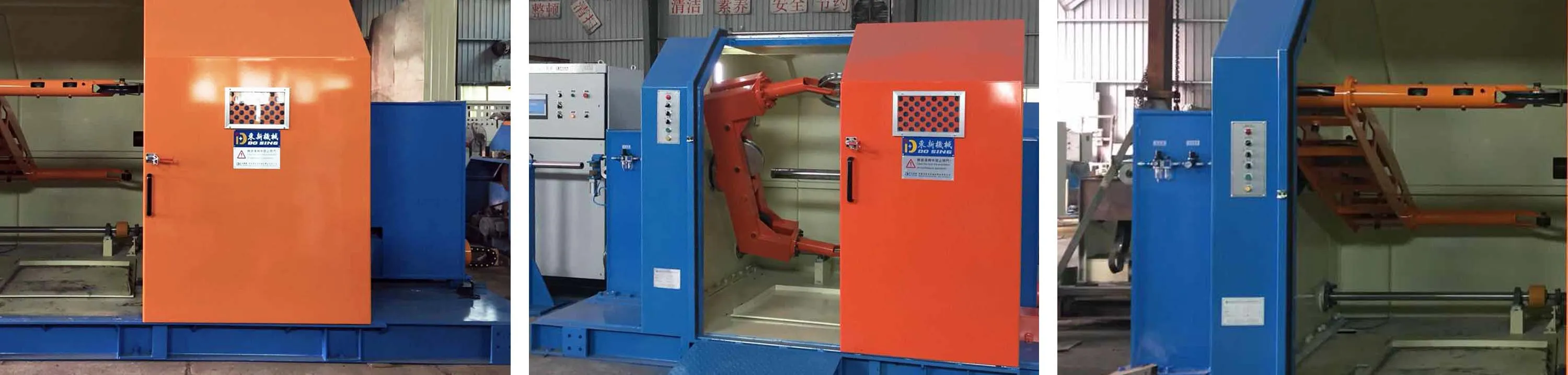
产品详情图片三张.jpg


Fine Wire Stranding: Tension Control Priorities

Fine wires are typically used in:

  • Data cables

  • Control cables

  • Automotive signal wires

  • High-strand-count conductors

Key characteristics of fine wire

  • Low tensile strength

  • High elongation sensitivity

  • Easily damaged by micro tension spikes

Common problems caused by improper tension

  • Frequent wire breakage at pay-off

  • Inconsistent lay length

  • Surface scratches from excessive friction

  • Hidden conductor fatigue that fails later in testing

Practical tension adjustment guidelines for fine wire

1. Use the lowest stable tension, not “safe” tension
Many operators increase tension to “be safe.”
For fine wire, this does the opposite.

Target principle:

The wire should remain straight and stable, but never stretched.

2. Prioritize tension consistency over tension value
A slightly higher constant tension is safer than a low but fluctuating one.

This is why active pay-off systems are strongly recommended for fine wire stranding. Passive systems often introduce micro-fluctuations that operators cannot see.

3. Minimize friction points along the wire path
Fine wire reacts strongly to:

  • Sharp guide angles

  • Poor surface finish on rollers

  • Misaligned dancer arms

Even small friction changes translate directly into tension spikes.


Thick Wire Stranding: Different Risks, Different Strategy

Thick wires are commonly used in:

  • Power cables

  • EV charging cables

  • Industrial and building cables

Key characteristics of thick wire

  • High mechanical strength

  • Lower elongation sensitivity

  • Greater inertia during rotation

Common problems caused by incorrect tension

  • Bird-caging during start/stop

  • Uneven strand compactness

  • Core deformation

  • Accelerated bearing and machine wear

Practical tension adjustment guidelines for thick wire

1. Increase base tension, but control inertia
Thick wire requires higher base tension to maintain:

  • Strand compactness

  • Stable lay geometry

However, inertia becomes the main enemy—especially during acceleration and deceleration.

2. Synchronize tension with machine speed ramps
Many stranding issues with thick wire occur not at full speed, but during:

  • Startup

  • Emergency stop

  • Speed transitions

Machines without proper tension-speed synchronization often cause sudden strand loosening or compression.

3. Reinforce mechanical alignment
With thick wire, misalignment doesn’t break the wire—it damages the structure.

Pay close attention to:

  • Pay-off shaft parallelism

  • Guide roller load rating

  • Bearing condition under sustained load


Side-by-Side Comparison: Fine Wire vs Thick Wire

ParameterFine WireThick Wire

Base tension level

Low

Medium to high

Sensitivity to fluctuation

Very high

Moderate

Main risk

Breakage, fatigue

Bird-caging, deformation

Pay-off recommendation

Active tension control

Active or reinforced passive

Startup behavior

Gentle, slow ramp

Controlled acceleration


Machine Design Matters More Than Operators Think

Many tension problems are blamed on operators—but in reality, machine design sets the limits.

Key features that directly impact both fine and thick wire stranding:

  • Precision dancer systems

  • Servo-controlled pay-off units

  • Stable take-up synchronization

  • Rigid machine frame to prevent vibration

A well-designed stranding machine allows operators to fine-tune tension, instead of constantly compensating for mechanical instability.


When Should Factories Re-Evaluate Their Tension Setup?

You should review your tension configuration if you see:

  • Increasing scrap without obvious defects

  • Inconsistent conductor resistance values

  • Frequent wire breakage after material changes

  • Higher maintenance frequency on guides and bearings

These are often tension-related symptoms, not material or operator issues.


Final Thoughts: One Size Never Fits All

Fine wire and thick wire may run on the same stranding machine—but they should never be treated with the same tension logic.

Understanding how wire diameter changes mechanical behavior allows factories to:

  • Reduce scrap

  • Extend equipment life

  • Improve long-term cable reliability

And most importantly, it turns tension control from guesswork into a controlled, repeatable process.


We use cookie to improve your online experience. By continuing to browse this website, you agree to our use of cookie.
Cookies
Please read our Terms and Conditions and this Policy before accessing or using our Services. If you cannot agree with this Policy or the Terms and Conditions, please do not access or use our Services. If you are located in a jurisdiction outside the European Economic Area, by using our Services, you accept the Terms and Conditions and accept our privacy practices described in this Policy.
We may modify this Policy at any time, without prior notice, and changes may apply to any Personal Information we already hold about you, as well as any new Personal Information collected after the Policy is modified. If we make changes, we will notify you by revising the date at the top of this Policy. We will provide you with advanced notice if we make any material changes to how we collect, use or disclose your Personal Information that impact your rights under this Policy. If you are located in a jurisdiction other than the European Economic Area, the United Kingdom or Switzerland (collectively “European Countries”), your continued access or use of our Services after receiving the notice of changes, constitutes your acknowledgement that you accept the updated Policy. In addition, we may provide you with real time disclosures or additional information about the Personal Information handling practices of specific parts of our Services. Such notices may supplement this Policy or provide you with additional choices about how we process your Personal Information.


Cookies

Cookies are small text files stored on your device when you access most Websites on the internet or open certain emails. Among other things, Cookies allow a Website to recognize your device and remember if you've been to the Website before. Examples of information collected by Cookies include your browser type and the address of the Website from which you arrived at our Website as well as IP address and clickstream behavior (that is the pages you view and the links you click).We use the term cookie to refer to Cookies and technologies that perform a similar function to Cookies (e.g., tags, pixels, web beacons, etc.). Cookies can be read by the originating Website on each subsequent visit and by any other Website that recognizes the cookie. The Website uses Cookies in order to make the Website easier to use, to support a better user experience, including the provision of information and functionality to you, as well as to provide us with information about how the Website is used so that we can make sure it is as up to date, relevant, and error free as we can. Cookies on the Website We use Cookies to personalize your experience when you visit the Site, uniquely identify your computer for security purposes, and enable us and our third-party service providers to serve ads on our behalf across the internet.

We classify Cookies in the following categories:
 ●  Strictly Necessary Cookies
 ●  Performance Cookies
 ●  Functional Cookies
 ●  Targeting Cookies


Cookie List
A cookie is a small piece of data (text file) that a website – when visited by a user – asks your browser to store on your device in order to remember information about you, such as your language preference or login information. Those cookies are set by us and called first-party cookies. We also use third-party cookies – which are cookies from a domain different than the domain of the website you are visiting – for our advertising and marketing efforts. More specifically, we use cookies and other tracking technologies for the following purposes:

Strictly Necessary Cookies
These cookies are necessary for the website to function and cannot be switched off in our systems. They are usually only set in response to actions made by you which amount to a request for services, such as setting your privacy preferences, logging in or filling in forms. You can set your browser to block or alert you about these cookies, but some parts of the site will not then work. These cookies do not store any personally identifiable information.

Functional Cookies
These cookies enable the website to provide enhanced functionality and personalisation. They may be set by us or by third party providers whose services we have added to our pages. If you do not allow these cookies then some or all of these services may not function properly.

Performance Cookies
These cookies allow us to count visits and traffic sources so we can measure and improve the performance of our site. They help us to know which pages are the most and least popular and see how visitors move around the site. All information these cookies collect is aggregated and therefore anonymous. If you do not allow these cookies we will not know when you have visited our site, and will not be able to monitor its performance.

Targeting Cookies
These cookies may be set through our site by our advertising partners. They may be used by those companies to build a profile of your interests and show you relevant adverts on other sites. They do not store directly personal information, but are based on uniquely identifying your browser and internet device. If you do not allow these cookies, you will experience less targeted advertising.

How To Turn Off Cookies
You can choose to restrict or block Cookies through your browser settings at any time. Please note that certain Cookies may be set as soon as you visit the Website, but you can remove them using your browser settings. However, please be aware that restricting or blocking Cookies set on the Website may impact the functionality or performance of the Website or prevent you from using certain services provided through the Website. It will also affect our ability to update the Website to cater for user preferences and improve performance. Cookies within Mobile Applications

We only use Strictly Necessary Cookies on our mobile applications. These Cookies are critical to the functionality of our applications, so if you block or delete these Cookies you may not be able to use the application. These Cookies are not shared with any other application on your mobile device. We never use the Cookies from the mobile application to store personal information about you.

If you have questions or concerns regarding any information in this Privacy Policy, please contact us by email at . You can also contact us via our customer service at our Site.