Русский
 Türkçe
 Tiếng Việt

Wire knotting is the kind of problem every cable factory knows but nobody enjoys talking about. It shows up suddenly, usually right when the operator thinks the line is stable. The rotor is running smoothly, the bundle looks fine, and then—within a single rotation—the wires collapse into a loop, pull tight, and the machine shuts itself down before something breaks.
When you open the bunch path, the situation is always the same: a small knot formed by one or two wires, twisted so tightly you have to cut everything out. One knot means a few hundred meters of scrap, plus lost time, plus the frustration of resetting the entire line.
After working with dozens of factories, one thing is clear: knotting is rarely caused by a single mistake. It’s almost always the result of several small issues that accumulate until the bundle can’t stay stable. Once you recognize the patterns, the problem becomes much easier to control.
Where Knotting Really Starts (and Why Most People Misdiagnose It)
Ask ten operators why knotting happens, and you’ll hear ten different answers:
“Bad wire.”
“High speed.”
“Wrong lay.”
“Humidity.”
“Maybe the rotor bearings.”
The truth is simpler: knotting begins the moment one core wire loses synchronization with the others.
It doesn’t have to be dramatic. A tiny drop in tension. A single scratch on the wire surface. A guide that’s just slightly worn. At 1500+ rpm, micro-problems become macro-failures.
A factory once sent us video footage slowed to 240 fps. The bundle looked stable—then in the next two frames (less than 0.01 seconds), one wire looped forward, overlapped, and tightened. That was all it took.
This is why simply slowing down the line never truly solves the problem. You have to find the root imbalance.
The Quiet Trouble-Maker: Payoff Tension Drift
Most knotting problems begin before the wire ever reaches the buncher.
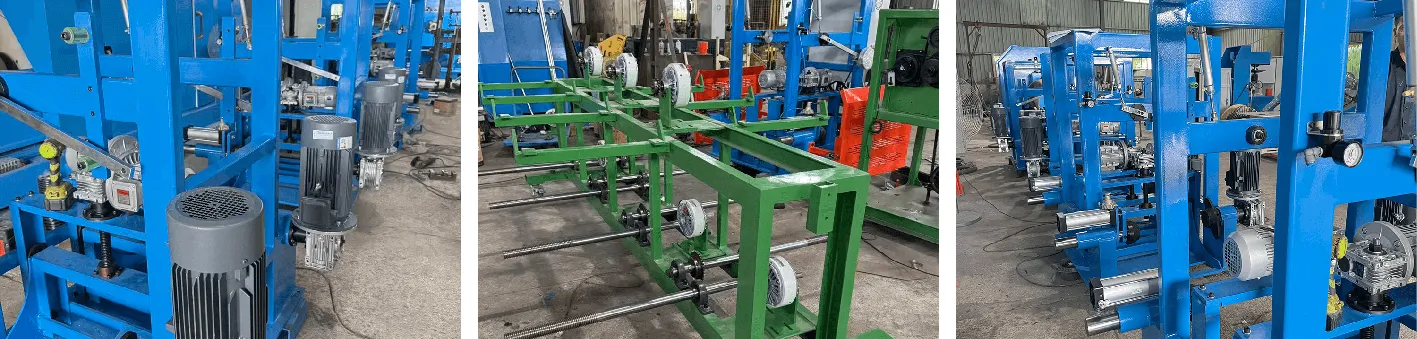
Payoffs are supposed to deliver each core with identical tension, but in real production environments this almost never happens.
Mechanical brakes warm up, and brake torque changes.
Old spools unwind unevenly.
A flange that’s bent just 1 mm can cause micro-surges during rotation.
Factories often ignore these things because they happen slowly. But at high speed, these small tension differences are exactly what destabilize the bundle.
One Southeast Asia factory had constant knotting on a 19-wire setup. After all kinds of adjustments, the real fix was embarrassingly simple: three payoffs had brake pads so glazed they delivered half the intended tension once the line was hot.
Replacing the pads cut knotting incidents by more than half.
If your knotting happens inconsistently—some days worse, some days better—payoff drift is almost always the first place to investigate.
Lay-Length Accuracy Isn’t Optional
Every buncher operator knows how important lay length is, but very few measure it consistently. Most trust the machine’s display. Unfortunately, real lay length and panel values rarely match perfectly.
Rotor speed drifts slightly as motors heat up.
Capstan belts expand during long hours.
Hard copper and soft copper don’t behave the same.
Tinned wire needs different back-twist than bare copper.
When lay length expands or shrinks just a little, the bundle shape changes. The wires begin to “breathe”—a very subtle ballooning effect. Once that breathing becomes uneven, knotting shows up almost immediately.
The factories that have the lowest knotting rates all do the same thing:
They measure the actual lay length every time they change spools.
Not once a week.
Not when there’s a problem.
Every single spool change.
It sounds strict, but it prevents a lot of trouble.
Surface Condition Matters More Than Specs
Many factories check wire diameter and resistivity, but rarely check surface condition.
Yet surface condition is one of the strongest predictors of knotting.
If copper has microscopic scratches, residue from drawing powder, or slight oxide, friction increases. Friction increases tension. Tension fluctuates with every rotation of the payoff. Then a loop forms, and the knot appears.
Soft copper is especially sensitive. Tinned copper even more so—tin flakes create tiny friction points that the operator can’t see but will absolutely feel during high-speed bunching.
We once advised a plant to simply wipe the incoming wire with a dry cloth right before feeding it into the buncher. For certain batches, the cloth turned almost black. Cleaning the wire reduced knotting incidents immediately.
Guides and Ceramic Eyelets: The Small Parts That Cause Big Losses
It’s unbelievable how often factories overlook guides. Guides get polished, grooved, pitted, and worn. Once they’re worn, they grab onto the wire for just a fraction of a second. That tiny grab causes a tension spike. The spike causes a loop. The loop becomes a knot.
Most factories visually inspect guides, but worn guides usually look fine. You have to feel them with your fingertip or run a wire through them and listen for a scratch.
If knotting happens consistently at the same physical location inside your machine—after the first pulley, at the entry guide, or right after the dancer—guide wear is the first thing to replace.
A $3 ceramic eyelet can cause $3,000 in downtime if you don’t replace it soon enough.
Wire Splicing Problems (One of the Most Underestimated Causes)
Bad splicing rarely shows up immediately. It shows up 10–40 meters downstream.
A splice that’s too stiff, too long, or not trimmed properly creates a momentary stiffness spike. The wire resists bending. The rotor pulls harder. The other wires surge ahead. That temporary imbalance creates—yes—another loop.
If your knotting increases on lines where the drawing team splices frequently, this is almost certainly the root cause.
Operator Habits That Matter More Than Machines
You can have the best machine, new guides, perfect wire, and still get knotting if operators skip small steps.
Every low-knot factory trains operators to:
Manually spin each payoff before startup
Check the first 10–20 meters of output for bundle stability
Physically measure lay length, not rely on the panel
Reject uneven or damaged spools
Clean guides at every shift change
The difference between a factory with frequent knotting and one with nearly none is usually discipline, not equipment.
Why Knotting Is a Management Problem, Not a Machine Problem
When you analyze knotting incidents across multiple factories, patterns become clear:
Knotting increases during hot seasons because tension changes.
Knotting increases when operators switch between copper suppliers.
Knotting increases when guides are replaced irregularly.
Knotting disappears almost overnight when payoffs are upgraded.
Knotting on older machines often comes down to capstan belts and encoders—not the buncher head.
In other words: knotting tells you how tightly controlled your entire production flow is.
The buncher is just the messenger.
When One Factory Finally Solved It
A mid-sized cable factory in India used to have 6–8 knotting stops per shift on a 26-wire setup. They blamed the machine for months. After a full audit, they discovered:
Brake pads were inconsistent
Ceramic guides had grooves
Lay length had a 1.8% drift
Incoming copper had residue from a new drawing lubricant
Reworking these four items dropped knotting to one stop every two days.
Their production output increased by 18% without buying a new machine.
That’s the scale of improvement possible when knotting is treated as an engineering problem instead of a “bad luck” event.
Final Thoughts
Wire knotting isn’t random.
It’s the visible symptom of invisible imbalances.
If you stabilize:
actual lay length,
wire surface,
guide condition,
and operator procedures,
your knotting rate will fall dramatically—usually within a week.
Explore the complete cable manufacturing system:
→ Cable Manufacturing Process & Equipment Guide