Русский
 Türkçe
 Tiếng Việt
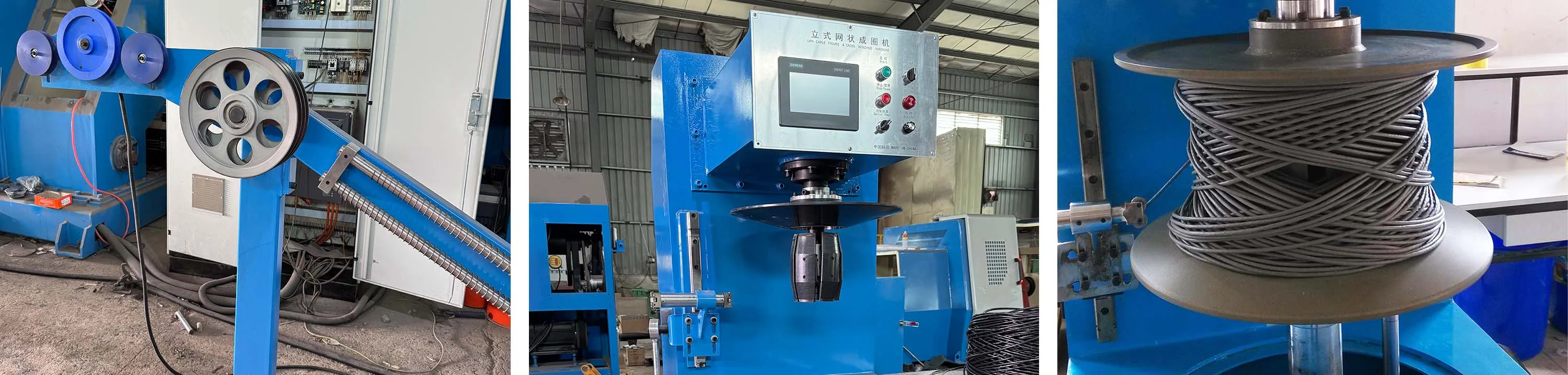
Coiling sounds simple: guide the finished cable onto a drum, stop when the spool is full. In modern high-speed lines it stops being simple the moment you push throughput, switch materials, or tighten tolerances. Tension problems at the coiler don’t just make ugly coils — they create downstream rejects, cause motor heating, change conductor geometry, increase splice failures, and quietly eat OEE.
This article walks through the deep causes of tension instability on high-speed coiling machines, shows how to diagnose the true root-cause (not the symptom), and lays out practical improvement strategies that engineers on production floors can implement today. Expect numbers, checks you can run in one shift, and examples from real plants.
Why tension matters (fast recap)
Tension at the coiler is not an isolated variable. It is the endpoint of a chain: payoff → capstan/drawdown → extrusion/taping → cooling → dancer → coiler. Any disruption anywhere shows up as a transient or steady tension change at the spool. At high speeds, tiny deviations amplify:
• A 0.5% speed mismatch between capstan and coiler can produce measurable OD change.
• A 0.05 N fluctuation on a 0.6 mm mini core is enough to cause layering defects.
• Tension spikes accelerate bearing wear and can double scrap rates in a day.
So you don’t fix coiler tension in isolation — you fix it by controlling the whole chain. But the coiler is where the symptoms appear and where corrective action is usually easiest to apply.
Common failure modes (what actually goes wrong)
Payoff variability
Payoff reels change effective torque as they unwind. Mechanical brakes heat and change coefficient of friction; spindle bearings develop play; spool mass drops and dynamic behavior shifts. These cause slow drift or periodic spikes.Capstan slip or miscalibration
Worn polyurethane coatings, contaminated surfaces, or belt slip let the capstan lose grip intermittently. Capstan is supposed to set drawdown — if it slips, tension control collapses.Dancer system lag and improper PID tuning
Dancers compensate for momentary differences between extrusion output and take-up. A PID tuned for stability at low speed will oscillate at high speed. Excessive integral action creates slow drift; over-aggressive proportional gain creates hunting.VFD / closed-loop communication issues
Encoder feedback noise, inadequate resolution, or timing jitter between drives creates micro speed variations that appear as tensile ripple.Mechanical friction & misalignment in coiler drive
Bearings, gearboxes, and shaft misalignment increase static torque. That makes the motor work harder, alters tension setpoints, and causes temperature drift. Heat changes component dimensions; dimension change changes tension — feedback loops form.Process changes (material properties, cooling, extrusion melt)
Different jackets, filler levels, or cooling profiles change stiffness and diameter. A stiffer cable needs different tension to lay correctly.Environmental factors
Ambient temperature, humidity, and air currents around the cooling tank or coiler can subtly change tension via material behavior or measurement distortion (laser gauges).
How to diagnose: a practical field protocol (one shift to actionable data)
Start with data. Collect before you "fix". You’ll often find the obvious once you chart it.
Step A — Baseline run and synchronized logging (60–90 minutes)
Log at 50–200 Hz where possible: capstan RPM, coiler RPM, dancer position, drawdown encoder, motor current, die pressure, laser diameter, and torque on coiler clamp (if available). Use timestamps.
Step B — Look for correlations, not single values
Plot dancer position vs torque; plot capstan RPM vs sudden pressure spikes. Are spikes correlated with payoff spool diameter change? Do torque jumps align to tape application or cooling tank turbulence?
Step C — Spectral analysis for periodicity
If problems repeat every X seconds, it’s mechanical (spool pattern, bearing beat, conveyor motor cycle). If random, focus on process (moisture, material papering) and control noise.
Step D — Static tests for mechanical friction
With line stopped and motor idle, rotate coiler by hand and feel/measure torque. Excessive torque indicates mechanical drag or misalignment.
Step E — No-load coiler test
Run the capstan and dummy the coiler with no cable. If tension ripple persists, coiler mechanics or motor control likely to blame. If ripple disappears, the upstream line (extruder/dancer/payoff) is the culprit.
Step F — Layer build test
Run at set speed and let first 10 layers form. Inspect for edge stacking, telescoping, or outer diameter growth. These visual signs tell you whether the tension setpoint needs raising, lowering, or smoothing.
Deep improvement strategies (engineering solutions that scale)
Payoff modernization — magnetic/servo tension
Replace mechanical brakes on critical payoffs with magnetic powder or servo tension payoffs. Advantages:
• Linear, temperature-stable torque
• No pad glazing or wear cycles
• Closed-loop control when combined with tension sensors
Practical target: keep torque variation <±2% across spool life.Capstan surface and control
Use fresh polyurethane or ceramic surface for capstan; keep surface clean and replace proactively. Add a torque sensor downstream of the capstan to detect slip. Tune capstan servo with encoder feedback and maintain slip ratio ≤ 1%.Dancer control tuning — critical parameters
Dancer systems must be re-tuned for high speed:
• Increase feedforward (if your controller supports it) to reduce lag
• Reduce integral time constant to avoid windup on long runs
• Use notch filters to remove known mechanical frequencies (e.g., bearing hum)
A pragmatic rule: tune for 1–2% overshoot max on step changes, minimal oscillation.Closed-loop tension control across stages
Don’t let single sensors control the whole line. Use a tension cascade:
• Payoff local control (micro) maintains local torque.
• Dancer governs mid-range drawdown.
• Coiler uses a slower loop for knot prevention and final tension setting.
This reduces amplification of small disturbances.VFD and encoder hygiene
Check encoder resolution; use > 10,000 CPR where possible on high-speed lines. Ensure shielded cabling, clean connector contacts, and synchronized sampling between drives. Lower carrier frequencies if you see heating related to switching losses.Mechanical preventive actions
• Laser align motor/gearbox/coiler shaft — not eyeball. Misalignment 0.2–0.5 mm causes vibration.
• Monitor bearing temperatures and vibration (fit accelerometers). Replace bearings at first sign of elevated RMS.
• Balance coiler spool and hub; unbalanced mass creates periodic torque ripple.Tension sensors and torque transducers where it matters
Inline tension sensors at the final guide before coil and torque transducers on coiler clamps allow accurate feedback. Use these sensors for SPC—track σ and drift; intervene when control limits exceed.Adaptive control and model predictive approaches
For high-value lines, implement adaptive tension controllers that estimate effective stiffness and inertia as layers build. Model predictive control (MPC) can pre-act for the rising moment arm as coil OD grows, reducing motor strain and tension overshoot.Cooling and environmental control
Stabilize air around the cooling tank and coiler. Avoid direct AC blasts or open doors near the laser gauge. For lines sensitive to humidity (LSZH or hygroscopic compounds), maintain 40–55% RH in the coiling area.Process standardization and change control
Every material change (compound, filler, sheath thickness) needs a documented re-tuning procedure. Keep a parameter library keyed by product SKU so operators don’t guess setpoints.
Hands-on fixes you can do this week
• Inspect and replace capstan coating; clean with isopropyl alcohol before each shift.
• Put a low-latency data logger on the dancer and capstan for one shift; review for spikes.
• Replace suspect bearings on the coiler shaft. Bearing friction is a common stealth source.
• Temporarily lower production speed by 5–10% during spool transitions and monitor rejection rate. If it falls, payoffs need attention.
• Add a simple low-pass digital filter to the dancer controller to remove 50–60 Hz noise from nearby machinery. Don’t over-filter — latency kills stability.
Two brief case studies from the floor
Case A — Mini cable line, jittery OD at layer 6
Symptoms: OD wobble and occasional telescoping at the coil outside. Analysis: spectral peaks at 0.67 Hz matched atop a particular bank of payoffs. Root cause: worn payoff bearing causing slight periodic drag. Fix: replaced bearings, rebalanced payoffs, added torque sensor. Result: immediate removal of spectral peak; scrap down 45%.
Case B — High-speed Type-C line, motor heating and tension spikes after 120 m
Symptoms: motor current rose while coil grew; tension spikes correlated with laser diameter noise. Analysis: cooling tank water flow fluctuated, causing laser noise; capstan responded to noisy feedback. Fix: installed a simple water flow stabilizer and shielded laser; added a median filter to the capstan controller. Result: motor current stabilized, production rate increased 12%.
Metrics to monitor (KPIs that matter)
• Tension standard deviation at coil point (target: < 0.05 N on mini cores).
• % of runs with telescoping or edge spikes (target: < 1%).
• Motor current rise per 100 m of coil (target: linear, predictable, small slope).
• Mean Time Between Knotting (MTBK) or mislayer events (target: improve 2× baseline within 3 months).
• SPC control limits on dancer position — if you see widening, it’s a drift issue not a one-off.
Checklist before scaling up speed
Payoff torque <±2% across spool life.
Capstan slip ratio ≤1%.
Dancer PID tuned and log shows <1% oscillation on step.
Inline tension sensor installed at coil.
VFD and encoder sampling synchronized.
Bearings & belt tensions within spec, laser shaft aligned.
Environmental conditions stable (temp & RH).
Operator SOPs updated for spool change-over and first 20 m inspection.
Closing thought
High-speed coiling machine tension problems are rarely “mysterious.” They are the visible symptom of interaction across mechanical, control, and process domains. Fixing them requires discipline: measurement first, then targeted remedial engineering. The most consistent gains come from removing mechanical surprises (bearings, coatings, alignment), modernizing payoffs and capstans, and using proper control strategies (cascade loops, tuned dancers, adaptive control).
Explore the complete cable manufacturing system:
→ Cable Manufacturing Process & Equipment Guide