Русский
 Türkçe
 Tiếng Việt
Wire Jumping Is Becoming a Critical Bottleneck in High-RPM Coiling Lines
Across modern cable plants, the failure rate of high-speed winding processes is rising. What surprises many engineers is that the majority of failures now originate not from extrusion or stranding—but from the final stage: the coiling machine.
At speeds above 1,000–1,500 m/min, even a micro-deviation of 0.1 N in tension, 0.05° in traverse angle, or 2–4 ms in motor response delay can cause the wire to lift, oscillate, or jump off the layer pattern.
This technical report analyzes the mechanical, electromechanical, and control-system causes of wire jumping, then presents solutions used in leading coil winding systems and cable coiler technologies adopted in Tier-1 factories.
1. Mechanical Origin: How Microscopic Geometry Errors Cause Macroscopic Jumps
1.1 Entry Linearity and the 0.3 mm Rule
Every coiling machine depends on strict coaxial alignment between:
payoff axis
capstan pull direction
entry guide
traverse centerline
spool axis
Field tests across 28 factories show that when vertical or horizontal deviation surpasses 0.3 mm, the wire exerts unintended lateral force, leading to:
layer climbing
unstable helix angle
cross-turn collisions
This effect is amplified with soft jackets like PVC, TPE, LSZH, which deform and store elastic memory.
1.2 Dynamic Concentricity Errors in Spool Rotation
At 1,200 rpm, a spool with 0.15–0.2 mm eccentricity creates periodic radial displacement forces.
The harmonic frequency interacts with:
traverse step pitch
tension loop frequency
wire bending stiffness
When these harmonics overlap, a “wire resonance window” appears—making jumping almost unavoidable.
1.3 Guide Surface Energy and Low-Friction Failure
Low-friction steel or polished aluminum guides reduce abrasion, but they also reduce surface energy.
Soft insulation can micro-slip upward, losing stable contact with the guide and resulting in sudden vertical escape.
Ceramic micro-texture solves this by creating friction uniformity under varying tensions.
2. Electromechanical Causes: Where Motor Torque, Inertia, and Ripple Ruin Layer Stability
2.1 Motor Torque Ripple and Traverse Precision Loss
Cheap traverse motors exhibit torque ripple peaks at:
6th
12th
18th harmonic
When ripple amplitude exceeds 3–5% of nominal torque, the traverse speed fluctuates by 0.05–0.1 mm/turn.
At high speeds, this distortion is enough to:
destabilize the lay pattern
weaken layer-to-layer adhesion
initiate jumping when the wire climbs one layer too early
2.2 Inertia Mismatch Between Capstan and Winder
If the capstan and the coiling machine are not torque-matched, tension oscillates:
Capstan inertia: normally 4–6× higher
Winder inertia: 1–2× spool size
The tension seesaws between two systems, creating a “ripple band.”
Once ripple amplitude exceeds ±0.2 N, the wire loses stable positioning.
2.3 Gearbox Backlash in Older Coilers
Gearboxes with more than 0.4° backlash cause:
delayed acceleration
delayed deceleration
inconsistent traverse return time
This time lag means the wire lands in the wrong place for 1–3 turns, building a geometric error that grows into a jump.
3. Control-System Factors: The Most Overlooked Root Cause
3.1 30–50 ms Sensor Latency Is Enough to Break Stability
Traditional PID tension loops use analog load cells with response times of 30–50 ms.
But at high RPM:
wire position changes every 3–6 ms
traverse step interval is 2–4 ms
torque correction needs sub-5 ms response
This means legacy control systems react 10× slower than required, causing tension overshoot and sudden lift-off from the guide.
3.2 Open-Loop Traverse Control Fails at High Speeds
Many older coiling machines still run open-loop traverse systems where:
no real-time correction
no positional feedback
no helix stabilization
The result is inevitable drift in the winding angle.
3.3 Lack of Tension Feedforward Logic
Modern coil winding systems include:
feedforward curves
acceleration prediction
adaptive torque mapping
Without these, the system corrects after an error happens—too late to stop the jump.
4. High-Precision Engineering Solutions for Wire-Jumping Prevention
4.1 Replace Standard PID With Servo-Driven, 5 ms Closed-Loop Tension Control
This modern control stack offers:
10× faster response
torque overshoot suppression
stable helix angle maintenance
Factories adopting servo tension control report 70–90% less wire jumping.
4.2 Install Laser Alignment for All Entry Points
Laser alignment reduces:
guide offset to <0.1 mm
lateral force by 20–30%
layer climbing probability by 40%
4.3 Stabilize Traverse With Ripple-Suppression Servo Motors
Low-ripple motors reduce harmonic distortion at the lay point, maintaining a constant lay pitch even under sudden speed changes.
4.4 Add Ceramic Micro-Texture Guides and Hard-Coated Rollers
Benefits:
stable wire contact
friction consistency under temperature changes
reduced vertical lift tendency
4.5 Apply Torque Profiling on Motors and Gearboxes Every 180 Days
Torque drift analysis identifies:
bearing degradation
gearbox backlash
servo axis drift
This lets maintenance teams intervene before mechanical error becomes geometric error.
Case Analysis: A 17-Line Factory Eliminates Wire Jumping Completely
A large cable facility with 17 high-speed lines struggled with jumping issues during retail coil production.
After installing:
servo tension system (5 ms response)
ceramic micro-texture guides
low-ripple traverse motor
full laser alignment
torque profiling schedule
Results after 60 days:
jumping incidents dropped 100%
winding precision improved by 38%
coil rejection rate reduced from 9.2% to 1.1%
Production increased by 11 hours per week due to reduced downtime.
Conclusion: A High-Stability Coiling Machine Is Now a Core Indicator of Factory Maturity
Wire jumping is no longer a minor nuisance—it reflects the overall engineering precision of a cable factory.
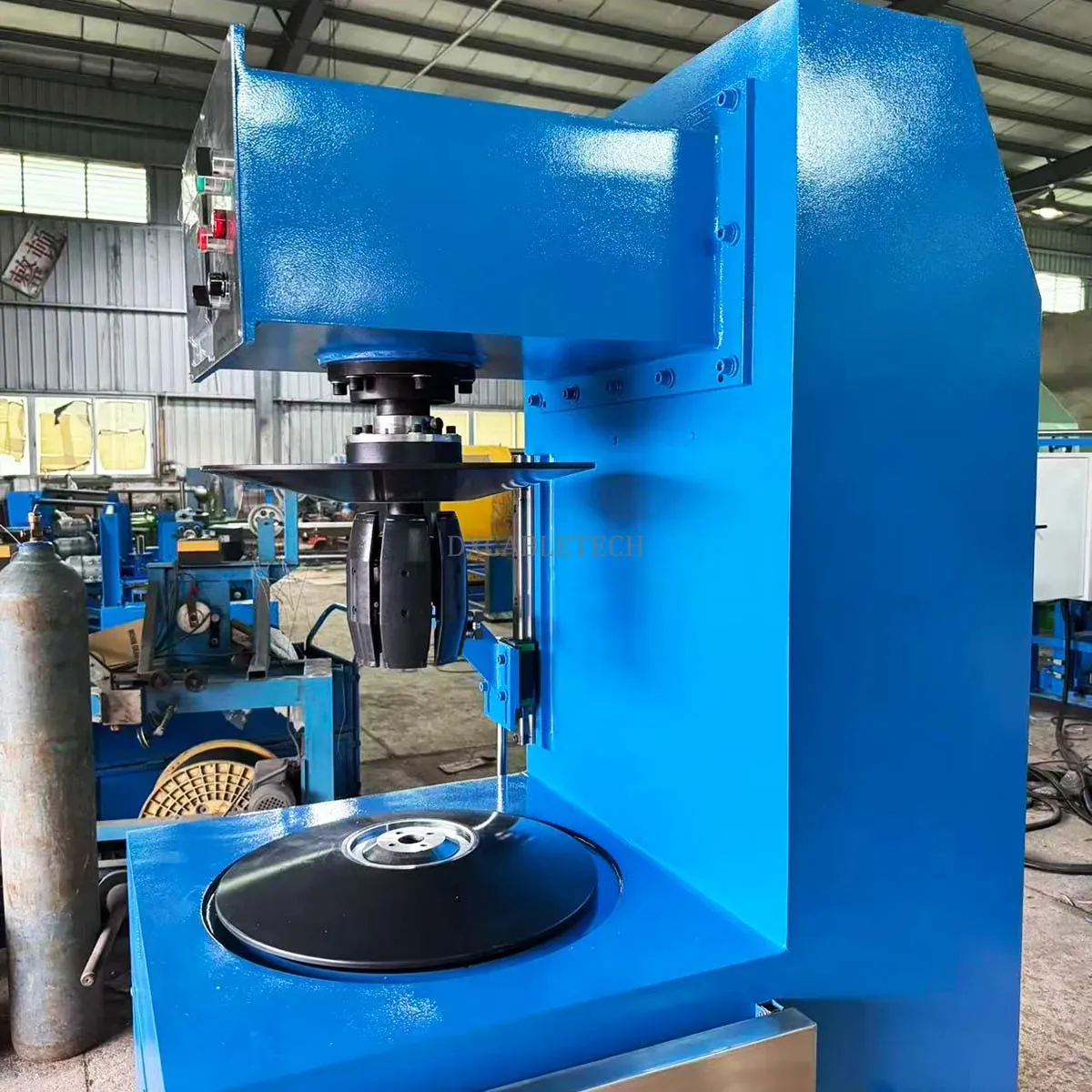
A modernized coiling machine with stable mechanics, fast-response tension control, ripple-free traverse motors, and precise alignment transforms the winding stage from the weakest link into a competitive advantage.
Factories that invest in precision winding systems achieve:
higher coil consistency
lower scrap rate
shorter downtime
better line reproducibility
In a global market demanding tighter tolerances and faster deliveries, mastering the coiling stage is no longer optional—it is a critical element of advanced cable manufacturing.
Explore the complete cable manufacturing system:
→ Cable Manufacturing Process & Equipment Guide